
401(k), IRA, and Brokerage Account Disputes in Texas: Why the Type of Account Decides Everything
When a loved one dies, families often expect the fight, if there is one, to be about the life insurance. Then they discover the real money is somewhere else. A 401(k). An IRA. A brokerage account with a transfer-on-death form. And the person named on that account is not who anyone expected, or is someone who should no longer be there at all.
These accounts are frequently the largest single asset in an estate, larger than the house and larger than the life insurance. They can be contested, but how you contest them, and whether you can win, depends almost entirely on one thing that most people never think about: what kind of account it is.
It is not just life insurance that gets fought over
Any asset that passes by beneficiary designation can become a dispute. That includes 401(k)s and pensions, traditional and Roth IRAs, brokerage and investment accounts with payable-on-death or transfer-on-death instructions, and bank accounts and CDs with POD designations. When two or more people claim the same money, or when the named beneficiary got there through pressure, fraud, or a form that was never updated, you have a fight worth having if the numbers are large enough.
But before you spend a dollar pursuing it, you need to know which rulebook applies.
The one question that changes everything: is it an ERISA account?
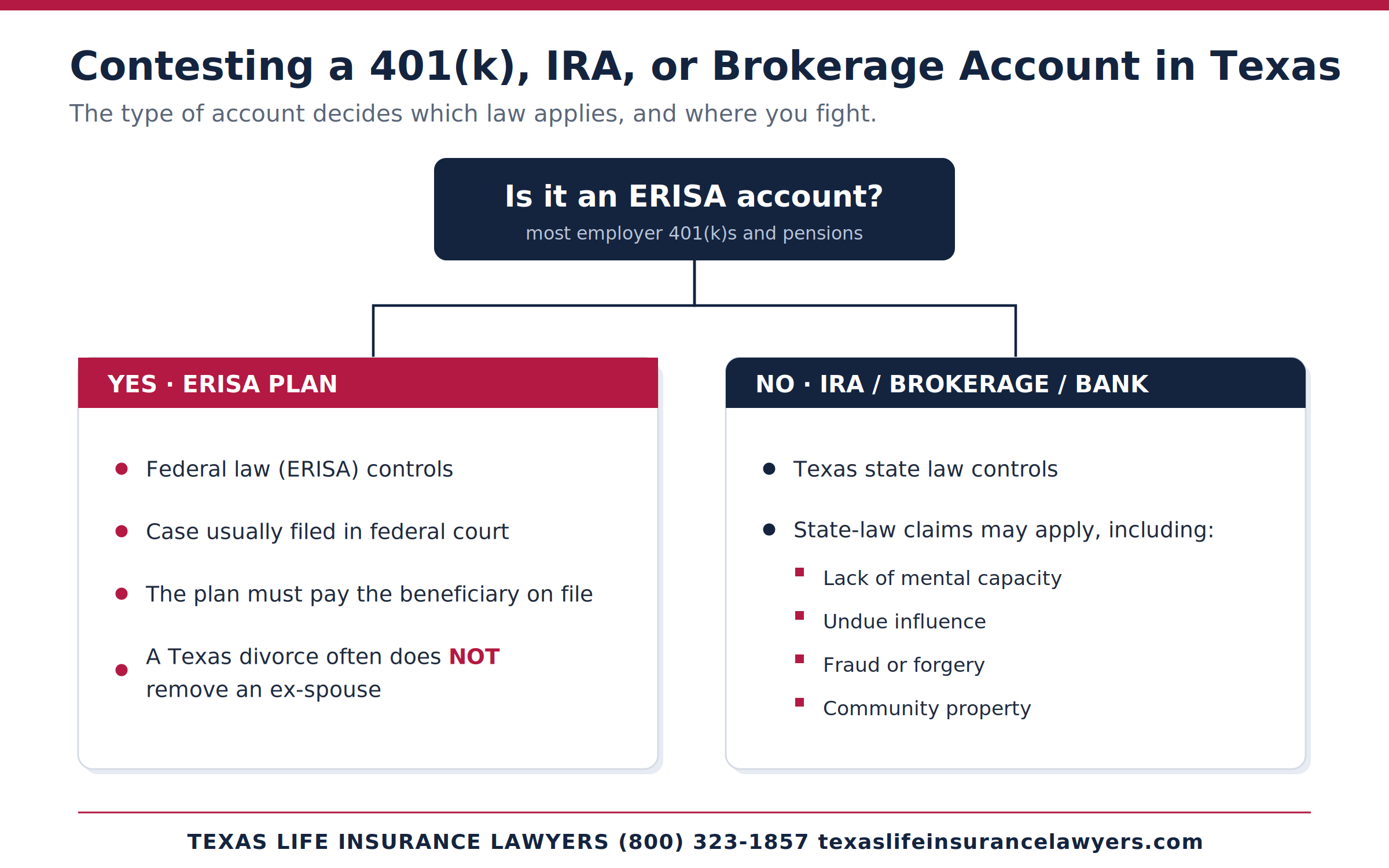
ERISA is the federal law that governs most employer-sponsored retirement plans. If the account is an ERISA account, federal law controls, the case usually belongs in federal court, and many of the Texas state-law protections you might expect simply do not apply. If the account is not an ERISA account, Texas law controls, and a very different set of tools opens up.
Getting this wrong at the start is one of the most common and most expensive mistakes people make in these disputes.
401(k)s and pensions: the plan documents usually win
Most workplace 401(k)s and pensions are ERISA accounts. Under ERISA, the plan administrator is generally required to pay whoever is named on the beneficiary form on file, following the plan documents to the letter. Intentions, side agreements, and even a divorce decree often do not change that obligation.
This is where families get blindsided by divorce. In Texas, state law automatically strips an ex-spouse of a beneficiary designation after divorce in many situations. People assume that rule protects them. For an ERISA 401(k) or pension, it usually does not. Federal law overrides the Texas automatic-revocation rule for these accounts.
The leading case on this, Kennedy v. DuPont, began right here in Texas. In a dispute that started with a Texas divorce and went all the way to the U.S. Supreme Court, a man named his wife as the beneficiary of his roughly $400,000 employer savings plan. They divorced, and she gave up her interest in the divorce decree. But he never changed the beneficiary form. When he died, the plan paid the money to the ex-wife, and the Supreme Court said that was correct, because the plan has to follow its own documents. The lesson is blunt: with an ERISA account, an outdated form can beat a divorce decree.
One more wrinkle worth knowing. In many employer plans, if you are married, your spouse is the default beneficiary, and naming anyone else requires your spouse's written, notarized consent. A designation that skips that step can be vulnerable.
Losing at the plan level is not always the end of the case
Here is what a lot of people, and some lawyers, miss. The rule that the plan must pay the named person decides who the plan writes the check to. It does not always decide who gets to keep the money.
Even when a plan is required to pay an ex-spouse or another named beneficiary, the estate or the intended heirs may still be able to go after that person afterward to enforce a waiver they signed, for example in a divorce. That is a separate lawsuit, it is fact-specific, and the law around it is unsettled. But it can be the difference between walking away empty-handed and recovering the money. Framing the case correctly from day one is what preserves that option.
IRAs and brokerage accounts play by different rules
Individual IRAs that a person sets up on their own are generally not ERISA accounts. Neither are most brokerage and investment accounts with transfer-on-death instructions, or bank accounts with POD designations. These are governed by Texas law and by the account contract.
That matters, because it puts the full range of Texas state-law claims back on the table, claims that federal preemption often blocks for a 401(k). You can challenge these designations on grounds that would be much harder to raise against an employer plan. It is the difference between being locked into a federal rulebook and being able to use every tool Texas law provides.
The grounds for contesting an account designation
Where state law applies, a beneficiary or POD designation can be challenged much like a will. Common grounds include:
• Lack of mental capacity. The person did not have the mental ability to understand what they were doing when they signed the designation. Texas courts have overturned POD designations on exactly this basis, including on accounts worth several hundred thousand dollars.
• Undue influence. Someone pressured or manipulated the person into naming them, so the designation reflects the influencer's wishes rather than the account holder's.
• Fraud or forgery. The signature is not genuine, or the person was deceived about what they were signing.
• Community property claims. In Texas, a surviving spouse may have a claim to their community share when a spouse used community funds to benefit someone else, sometimes called a fraud-on-the-community claim. These claims are strongest against non-ERISA assets, since federal law limits them for employer plans.
Which of these fit depends on the facts, and often on records you do not have yet.
When the money is frozen: interpleader
When a company faces competing claims to the same funds and does not want to guess wrong, it often files an interpleader. It deposits the disputed money with the court, steps aside, and lets the claimants fight it out. For an ERISA account, that fight usually happens in federal court.
Interpleader is not a dead end. It is frequently where these cases are won or lost, and it is a core part of what we do. If you have received an interpleader notice, or you have been told the funds are being sent to a court, that is a signal to get counsel involved quickly, not to wait and see.
Winning often means acting before the money is paid out
The single most important factor in many of these disputes is timing. Once an institution pays the funds to someone else, recovering them becomes far harder and far more expensive. Evidence gets stale, witnesses scatter, and money gets spent. If you believe an account designation is wrong, the time to act is before the check is written, not after.
Talk to a Texas beneficiary dispute attorney
If a 401(k), IRA, brokerage account, or other beneficiary designation does not add up, you do not have to accept it, and you should not assume it is out of reach just because it is not a life insurance policy. The type of account changes the strategy, and knowing the difference early is what protects your claim.
Our firm handles contested beneficiary and account designation disputes across Texas, including interpleader cases in Texas federal courts, and we take most of these matters on a contingency fee basis, so you can pursue a strong claim without paying legal fees up front.
Call (800) 323-1857 for a free, straightforward evaluation of where your case stands.
